
Que scripsit scripta, sua manus sit benedicta. Anno domini M°CCCCC°xxiiij scripsi ego, soror Cecilia Hughen, hunc librum cum fauore venerabilis domine nostre A R, anno etatis mee XXIII°. Que librum istum post obitum meum possederit, oret amore Ihesu et Marie pro scriptrice Aue Maria Requiem
May the hand of her who wrote this text be blessed. In the year of our Lord 1524, I, Sister Cecilia Hüge, wrote this book with the favour of our venerable Domina A[nna] R[oden], at the age of 23. Whoever possesses this book after my death, may pray for the love of Jesus and Mary a Hail Mary and Requiem for the female scribe.
(Stuttgart, Landesbibliothek, Cod. brev. 22, fol. 419v)
A Graphic Novel From the Past
In 1524 – exactly 500 years ago – Cecilia Hüge, nun and later prioress of Neukloster Buxtehude, completed her prayer book, as recorded in the manuscript’s closing lines on fol. 419v. The small but fat prayer book (419 folios of 17.5 x 12 cm, about postcard size) includes Latin and Low German texts for the period from Holy Saturday to the fifth Sunday after Easter. These texts, based on the liturgy of the Divine Service, explaining and expanding it, were meant for the personal devotion of individual nuns. The volume, now held in the Landesbibliothek Stuttgart (Cod. brev. 22), is currently the only prayer book definitely attributed to Neukloster Buxtehude via its colophon quoted above. The former Benedictine convent was founded in 1270 in Neuenkirchen, relocated to Buxtehude in 1286 and remained active until 1705.
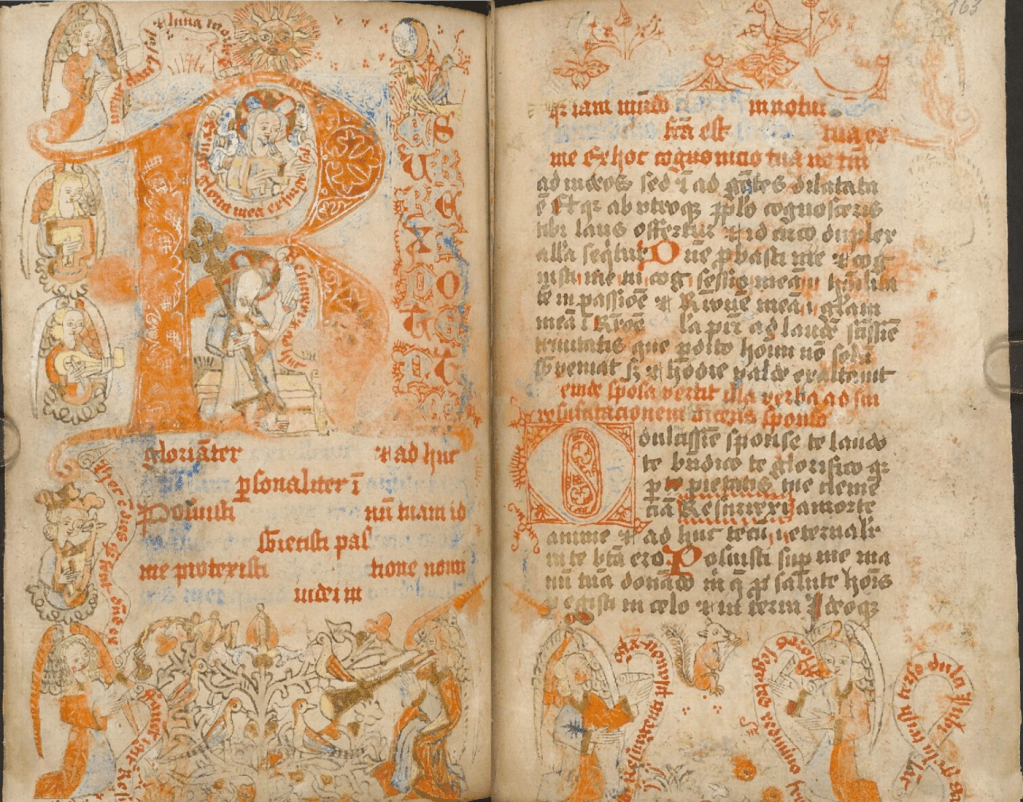
So far, this volume has fallen through the cracks—too late to be classified as a genuinely ‘medieval manuscript’, yet not fitting neatly into the narrative of Renaissance art. Cecilia’s prayer book possesses a highly distinctive style of its own, following earlier models of book production, but blending these with fresh impulses. A striking example is the double spread (162v–163r), which presents a theologically complex composition of text, a historiated initial, colorful marginal illuminations, and scrolls that comment on the events of the page—much like speech bubbles in a graphic novel.
In the R initial, God the Father (upper compartment) calls upon God the Son (lower compartment) to rise. Christ answers the call with the word RESURREXI (I have risen!), which appears both in his speech bubble and in the main text. Above the initial, the sun and moon join in the celebration, their presence explained by an angel quoting a line from the Easter sequence Laudes Salvatori. A host of angels contributes to the joyful scene with a variety of musical instruments, as does King David with his harp, accompanied by a chorus of birds—and even a squirrel! Although the volume has suffered significant water damage, washing out much of the blue text, and employs a limited color palette, its exuberant, celebratory mood remains vividly intact.
What to Expect in the Future
There is much more to explore in these manuscripts which bridge the medieval and the early modern, giving a vivid insight into how female devotion shaped mystical thinking about Christian topics. This preliminary investigation of Cecilia’s Easter prayer book is starting point for further investigations into the corpus. Updates on further findings will be posted on this blog.
 Neukloster Buxtehude