

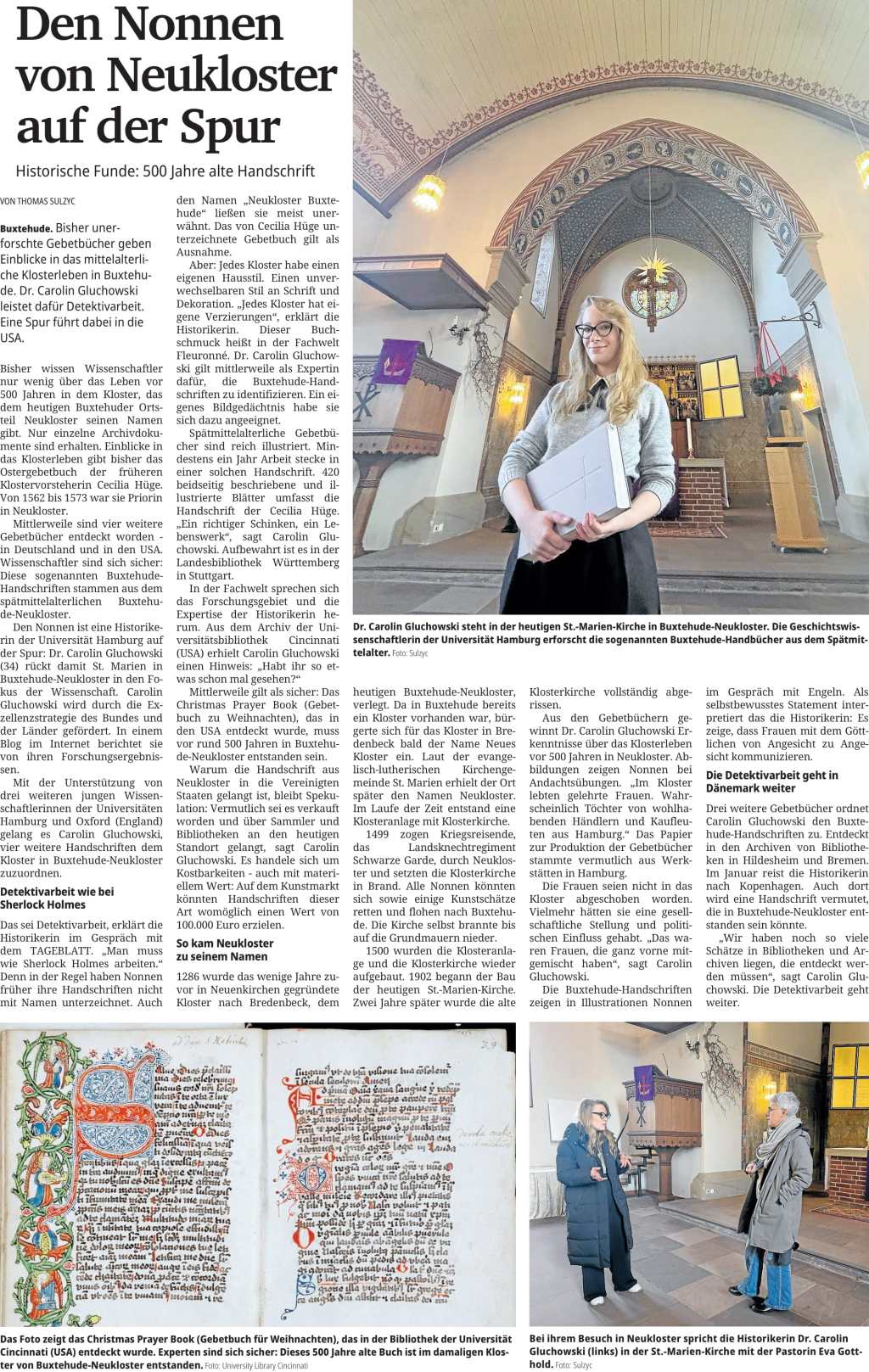
In late 2025 the regional newspaper Buxtehuder Tageblatt published an article about my research on the late medieval prayer books from the former Cistercian convent of Neukloster in Buxtehude. Under the title “Den Nonnen von Neukloster auf der Spur” (“On the trail of the nuns of Neukloster”), journalist Thomas Sulzyc presents the project as a kind of historical detective story: from a single well-known manuscript to a growing group of prayer books that can be traced back to Neukloster and now lie scattered across libraries in Germany and the United States. The print layout shows two central images: one of me standing with a manuscript box in today’s St. Marien church in Buxtehude-Neukloster, and another of the so-called Christmas Prayer Book held in the University of Cincinnati Library.
For a long time, almost everything historians knew about life in Neukloster around 1500 came from a few archival documents and one famous manuscript: the Easter prayer book of Cecilia Hüge, who served as prioress in Neukloster from 1562 to 1573. This substantial volume, now preserved in the Landesbibliothek Württemberg in Stuttgart, contains more than four hundred folios of carefully written and decorated text. It is a monumental work of devotion, but also a rare document of a named woman’s voice and authorship. In the interview I explain that Cecilia’s book was long treated as an exception; only recently has it become clear that it belongs to a larger group of manuscripts that share the same style and origins.
Together with colleagues from other universities, I have been able to identify four additional prayer books that almost certainly came from Neukloster. They are now located in libraries in Bremen, Hildesheim and Cincinnati, and there are indications that another manuscript in Copenhagen may also belong to the same group. Because of their common features in layout, script and decoration, I refer to them collectively as the “Buxtehude manuscripts”. The article nicely captures this process of attribution as “detective work”: the nuns rarely signed their books or wrote “Neukloster Buxtehude” into them, so we have to read the clues in other ways. Each medieval convent cultivated a kind of “house style” in its writing and ornament. Over time, I have developed a visual memory for the particular forms of initials and pen-flourishing that mark a book as a product of Neukloster.
The Christmas Prayer Book in Cincinnati is a good example. When colleagues there contacted me with the question “Have you seen something like this before?”, my first impression was that the decoration looked strikingly familiar. A closer comparison of script, layout and textual features with the Cecilia Hüge manuscript and other pieces of evidence confirmed the suspicion: this small but richly decorated book of prayers for the Christmas season was written for the nuns of Neukloster around five hundred years ago. How it travelled from a rural convent near Buxtehude to an American university library is impossible to reconstruct in detail, but it was probably sold in the early modern or modern period and passed through several private collections before arriving in its current home.
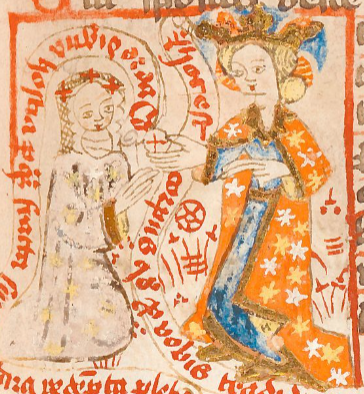
My research uses these prayer books to explore everyday religious life in Neukloster: how the nuns prayed through the liturgical year, which saints mattered to them, how they described their relationship to God and to the heavenly world. The books are written in both Latin and Low German, reflecting a community that moved confidently between a learned, international language and the vernacular of northern Germany. The images in some of the manuscripts show nuns engaged in devotional exercises or in conversation with angels. I interpret these not simply as pious decoration, but as visual statements about the spiritual standing of the women who used the books: they present themselves as people who could speak with the divine “face to face”, without needing male intermediaries.
In the interview I stress that these were not passive or marginal figures. The daughters of wealthy merchants and citizens from nearby urban centres such as Hamburg most likely entered the convent with a solid educational background and strong family networks. Within the cloister they continued to participate in the intellectual and religious debates of their time, copied and adapted texts, and commissioned costly manuscripts on fine paper that probably came from Hamburg workshops. Far from being “parked” in the monastery, they occupied a respected social position and exercised influence in regional politics and economy. As I put it in the article, these were women who “played an active part at the front”, and the Buxtehude manuscripts help us to see that more clearly.
Even after these recent finds, there are likely still many undiscovered treasures in library stacks and archives across Europe and beyond. Part of my ongoing work involves following new leads, including the suspected Neukloster manuscript in Copenhagen, and continuing the slow, patient comparison of scripts, decorations and texts that allows us to connect scattered books back to their original communities. In that sense the detective work is far from finished. At the same time, the coverage in the Buxtehuder Tageblatt shows how this specialised research can feed back into local memory, reminding people in and around Buxtehude that their landscape once included a vibrant women’s convent whose books now travel the world. This blog will continue to document that journey and share new discoveries as they emerge.
 Neukloster Buxtehude
Leave a comment