

Cecilia Hüge’s Easter prayer book does not treat Easter as a feast that ends on Sunday morning. Instead, it presents the whole week after Easter as a sustained time of joy. That is very much in keeping with the liturgical idea of the Easter Octave: the eight days from Easter Sunday to the following Sunday were understood as an extension of the feast itself, a way of prolonging Easter joy rather than confining it to a single day.
This is exactly what we find in Cecilia’s manuscript. The book, written in 1524 and securely linked to Neukloster Buxtehude through Cecilia’s own colophon, contains texts from Holy Saturday to the fifth Sunday after Easter. After the great liturgical and devotional density of Holy Saturday and Easter Sunday, the days from Easter Monday to Easter Saturday are treated more briefly, but still in a highly structured way.
The section begins on fol. 245v with a striking rubric that makes its message explicit: Easter is to be celebrated not for one day only, but for seven. In other words, the Resurrection spills over the limits of Easter Sunday and reshapes the entire week. That is one of the most important things Cecilia’s prayer book tells us about Easter week at Neukloster Buxtehude: it was not an aftermath, but an unfolding. The joy of the feast had to be extended, revisited, and deepened day by day.
The manuscript does this through the titles of the days, many of them taken from the liturgy, especially from the opening chants of the Mass. Easter Monday is introduced with Introduxit, from the introit Introduxit vos Dominus in terram fluentem lac et mel — “The Lord has brought you into a land flowing with milk and honey.” In Cecilia’s prayer book, this becomes a meditation on arrival, fulfilment, and abundance: Easter means that Christ has led the faithful into a new spiritual landscape full of sweetness and joy.
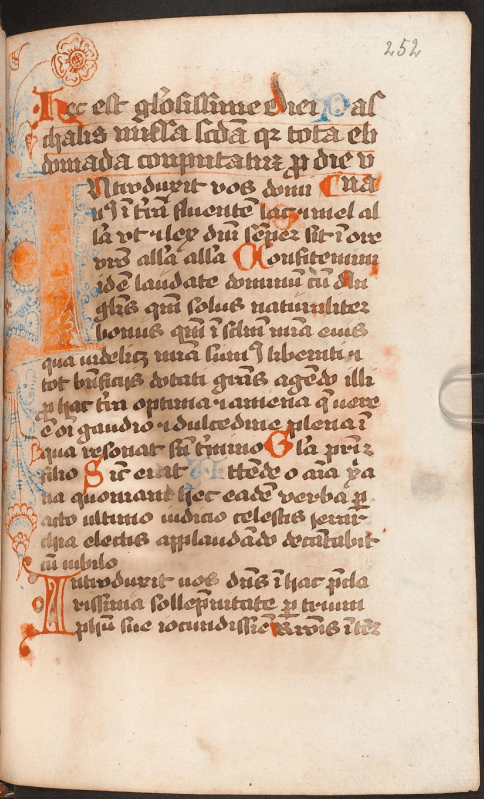
Easter Tuesday bears the title Aqua sapientiae, “the water of wisdom.” Here the Resurrection is imagined as overflowing sweetness and joy, so abundant that all creation celebrates with Christ. Easter Wednesday, Venite benedicite, turns the day into an invitation: “Come, you blessed.” The opening of heaven and the promise of beatitude are brought to the fore. Easter Thursday, Victricem, stresses Christ’s victory — the risen Lord is the one who broke hell, bound the devil, and now draws all things to himself. Easter Friday and Easter Saturday both use the title Eduxit, but in different ways: Friday is interpreted as a day of liberation, while Saturday looks forward to final fulfilment and eternal jubilation.
What emerges from this sequence is a devotional theology of Easter week. Each day has its own tone, but together they form a continuous movement: from arrival and sweetness, through blessing and victory, toward liberation and ultimate consolation. The manuscript repeatedly insists that the whole week can be understood as one extended feast. In that sense, Cecilia’s prayer book reflects the broader liturgical logic of the Easter Octave while also reshaping it for personal devotion.
Comparison with the better-studied prayer books from Medingen suggests that this was not unique to Buxtehude. In Winheid’s Easter prayer book, too, Easter Monday to Saturday are presented as a shorter but coherent sequence after the great celebrations of Holy Saturday and Easter Sunday. That similarity points to a wider North German convent culture in which Easter orationalia organised the feast not simply around one climactic day, but around a whole week of meditative and liturgical continuation. At the same time, Cecilia’s manuscript remains distinctive, and much more work is needed before we can describe in detail what was specific to the devotional profile of Neukloster Buxtehude and what it shared with other women’s convents in the region.
What Cecilia’s prayer book already shows very clearly, however, is this: Easter week at Neukloster was not a winding-down after the feast. It was a carefully structured continuation of resurrection joy. The nuns did not simply remember Easter once and move on. Through chant, prayer, and meditation, they were invited to remain within its light for eight days — and, in a sense, to experience the whole week as one long day of joy.
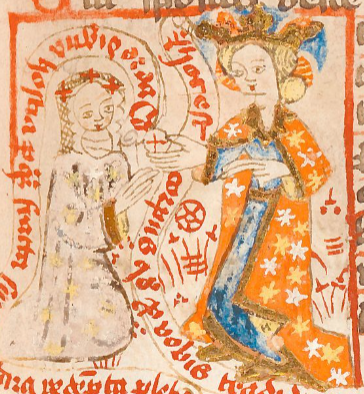
 Neukloster Buxtehude
Leave a comment