

Among the most striking features of Cecilia Hüge’s Easter prayer book are its repeated images of the Agnus Dei, the Lamb of God, as a figure of the risen Christ. All the illuminations discussed here belong to the Easter sequence of the manuscript, and that is crucial. They are not generic devotional images, but Easter images that place the nuns of Buxtehude in direct proximity to the victorious Lamb — the Christ who was slain, yet lives. In these scenes, the women are not pushed to the margins. They kneel before the Agnus Dei, meet him with their gaze, and are drawn into his presence. In this way, the manuscript gives visual form to a central aspect of late medieval women’s devotion: the nun as bride of Christ, active worshipper, and participant in salvation history.
Let us begin with one of its most remarkable miniatures: the image on fol. 229r (Fig. 1). At the centre stands Christ as the Agnus Dei, the Lamb of God. The image is visually compelling: the Lamb is large, luminous, haloed, and carries the Resurrection banner. Blood flows from its side into a golden chalice set directly before it. Two angels frame the scene above, while two kneeling nuns occupy the lower register. The composition creates a vertical axis between heaven and earth, but it also draws the earthly women into unusually close relation with the central figure of Christ. This is not a marginal or incidental image. It is a concentrated theological statement.
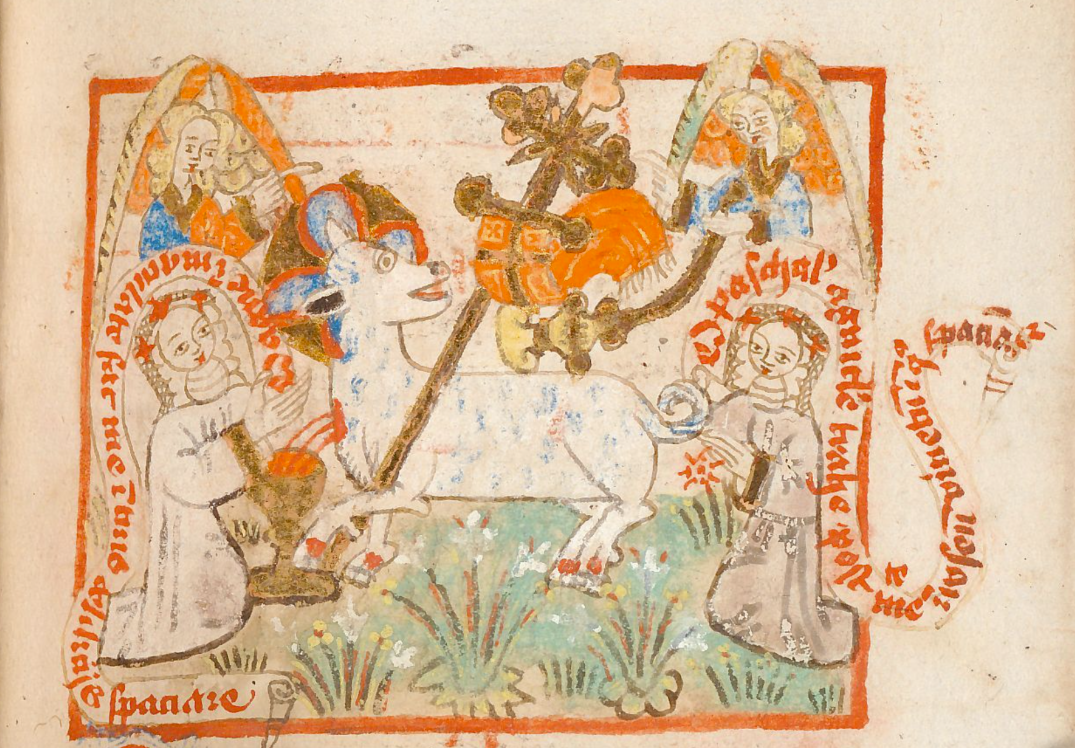
The symbolism of the Agnus Dei would have been immediately legible to a late medieval reader. The title “Lamb of God” comes from John the Baptist’s proclamation in John 1:29, and the Book of Revelation develops the image of the Lamb into one of the central symbols of the glorified Christ: slain, yet victorious and standing in divine power. In Cecilia’s miniature, those meanings are brought together. The wounds recall the Passion, the banner signals the Resurrection, and the chalice points toward the Eucharist. Christ is shown here not simply as suffering victim, but as the risen Lamb whose sacrifice remains active and present.
What makes the image especially striking is the position of the nuns. They do not stand far off, nor are they mediated through a priest, donor, or male confessor. Instead, they kneel directly before the Lamb and fix their gaze upon him. Their presence is not decorative. It is devotional and participatory. The image gives them a place within the economy of Easter salvation. Both women wear the crowns that mark them as brides of Christ, but they are shown in different habits, one brighter, one darker. Whether this contrast reflects different moments of reform or differing communal identities remains to be studied more closely. What can be said already, however, is that the miniature presents the women as active figures in a devotional exchange that joins the earthly and heavenly realms.
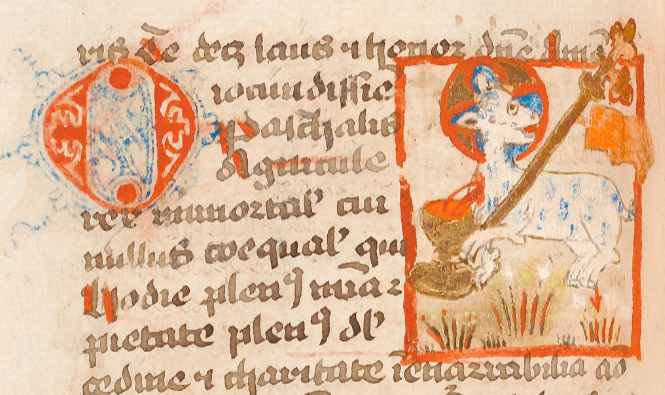
Figure 2: Stuttgart, Württembergische Landesbibliothek, Cod. brev. 22, fol. 141v.
This is not an isolated motif. The Agnus Dei appears elsewhere in Cecilia’s prayer book, for example on fol. 141v, where the Lamb is shown alone within a red frame, again carrying the Resurrection banner (Fig. 2). Repetition matters in manuscripts like this. When a motif returns, it becomes part of the reader’s visual memory and devotional vocabulary. The repeated presence of the Paschal Lamb suggests that the image was central to the manuscript’s Easter theology: the risen Christ is not only proclaimed in text, but made repeatedly visible to the reader.

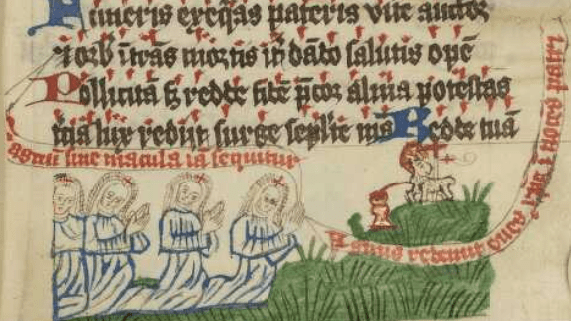
The Buxtehude image is not without parallels. A closely related formula appears in the Medingen manuscript now Hannover, Gottfried Wilhelm Leibniz Bibliothek, Ms. I 75, an Easter prayer book from the larger corpus of women’s devotional books associated with the Cistercian convent of Medingen (Fig. 3). The Medingen corpus today comprises more than sixty-five manuscripts, and Ms. I 75 is listed there as an Easter prayer book. In its Agnus Dei image, a group of nuns venerates the Lamb in a way that clearly belongs to the same wider visual tradition as the Buxtehude miniature. This tells us that Cecilia’s illuminations are not simply eccentric or isolated inventions. They belong to a broader North German convent culture in which women repeatedly imagined themselves in close relation to Christ.
At the same time, Buxtehude’s version seems to press the motif further. What stands out is not simply the presence of nuns before the Lamb, but the closeness of the encounter. The Lamb dominates the centre, the chalice sits in the foreground, and the earthly worshippers are drawn tightly into the same visual field. The result is an image of striking immediacy. Rather than placing the women at a safe devotional distance, the miniature suggests intimacy, access, and proximity. The women are not merely looking toward salvation. They are positioned as if already admitted into its presence.
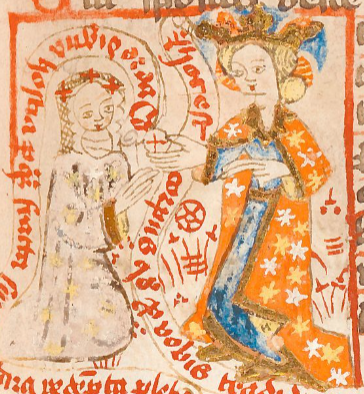
This reading becomes even more compelling when the image is set beside the Easter prayer book written in 1478 by the nun Winheid, now Hildesheim, Dombibliothek, Ms. J 29. Winheid’s manuscript is part of the same broader world of Latin and Low German women’s prayer books, and the uploaded edition shows just how strongly it imagines the female devotee as Christ’s bride.
In one Easter Mass meditation, the bride is led into the bridal chamber, gazes upon Christ’s wounds, kisses the Lamb three times, and receives the breath of the Spirit from him. In another passage, the bride is fed by the Paschal Lamb and contemplates Christ as her bridegroom. Elsewhere, Winheid explicitly prays that she may one day see Christ, “the immortal bridegroom,” in his majesty. These are not minor details. They show that in this devotional culture the bride-of-Christ imagery was not decorative language alone, but a fully developed spiritual model for imagining intimate contact with the risen Christ.
Seen in this wider context, the Buxtehude miniatures begin to look less like pious illustration and more like visual theology. They stage what the texts of related Easter prayer books describe: that the nun, as bride of Christ, is granted a privileged devotional closeness to the glorified Lord. The women in these images are not passive recipients of clerical instruction. They are depicted as worshippers, contemplatives, and participants in the Easter mystery. Their role is active. They look, kneel, adore, and, by implication, intercede. The imagery thus gives strong visual form to female devotional agency.
That does not mean the images straightforwardly proclaim modern “empowerment,” nor do they prove that the nuns rejected every form of male religious authority. The manuscripts were, after all, produced within institutional and sacramental structures still shaped by male clergy. But the images do show something important: within their devotional world, the nuns could imagine themselves in immediate relation to the risen Christ, without a male figure occupying the scene between them. That is a powerful visual claim. On Easter Sunday, of all days, the manuscript presents the women not at the edge of salvation history, but at its very heart.
Much more research remains to be done. The Buxtehude corpus is small, and the liturgical and visual logic of Cecilia Hüge’s manuscript still needs to be studied in fuller detail and compared more systematically with the Medingen prayer books. Only then will it become possible to describe more precisely what was distinctive about the devotional profile of Neukloster Buxtehude and what it shared with other women’s convents in northern Germany. But even at this stage, the Easter images already show something remarkable: they testify to a female devotional culture in which the risen Christ could be encountered directly, lovingly, and with striking spiritual confidence.
Short bibliography
Cyrus, Cynthia J. The Scribes for Women’s Convents in Late Medieval Germany. Toronto: University of Toronto Press, 2009.
Jones, Claire Taylor. Ruling the Spirit: Women, Liturgy, and Dominican Reform in Late Medieval Germany. Philadelphia: University of Pennsylvania Press, 2017.
Lähnemann, Henrike. “From Devotional Aids to Antiquarian Objects: The Prayer Books of Medingen.” In Reading Books and Prints as Cultural Objects, edited by Evanghelia Stead, 33–55. Cham: Palgrave Macmillan, 2018.
 Neukloster Buxtehude
Leave a comment