

For a long time, the manuscript culture of Neukloster Buxtehude seemed to rest on a single surviving book.
In 1524, the nun Cecilia Hüge completed a small but substantial Easter prayer book: a 419-folio paper manuscript, now preserved in Stuttgart as Cod. brev. 22. Written for the period from Holy Saturday to the fifth Sunday after Easter, it brings together Latin and Low German texts for prayer, liturgy, and meditation. At the end of the book, Cecilia identifies herself as its scribe and asks future readers to pray for her after her death.
This manuscript has often been treated as an exceptional survival: a rare personal devotional book from a North German women’s convent on the eve of the Reformation. But what if Cecilia’s book is not an isolated witness? What if it is instead the first visible point in a much larger manuscript tradition?
In my recent article, “Die Buxtehuder Handschriften. Lateinisch-niederdeutsche Gebetbücher aus Neukloster als Zeugnisse weiblicher Frömmigkeit,” I argue that Cecilia Hüge’s prayer book belongs to a small but rapidly emerging corpus of Latin-Low German manuscripts from Neukloster Buxtehude. These books open up new perspectives on female devotion, manuscript production, and the history of Low German in late medieval and early modern North Germany.
A Convent Between Reform and Resilience
Neukloster Buxtehude was founded in the thirteenth century and later became a Benedictine women’s convent dedicated to Mary and St John the Evangelist. Its history was shaped by reform, crisis, and remarkable continuity.
In 1477, Neukloster joined the Bursfelde Congregation. Five nuns from the reform convent of Ebstorf helped introduce the reform, and the surviving account presents the process not simply as an imposition from outside, but as a transformation in which the convent itself participated. A generation later, in 1499, the convent suffered a severe blow when the Black Guard attacked and largely destroyed it. Letters sent to the Benedictine nuns of Lüne show both the hardship experienced by the Buxtehude nuns and the support offered by neighbouring women’s convents.
When the Reformation later reached Buxtehude and Stade, Neukloster again took a distinctive path. While the surrounding towns adopted Lutheran teaching, the convent initially held to the old rite and remained Catholic for a considerable period in a largely Lutheran environment. This makes its books especially interesting: they were produced and used in a community negotiating between late medieval reform piety and early modern confessional change.
From a Single Book to Five Manuscripts
The article brings together a corpus of five manuscripts that can, with high probability, be connected to Neukloster Buxtehude.
The starting point is Cecilia Hüge’s Easter prayer book in Stuttgart. To this can now be added two manuscripts in the Staats- und Universitätsbibliothek Bremen: a Low German Passion prayer book and a large, predominantly Latin Christmas orationale. A further Latin-Low German Christmas prayer book is preserved in the Dombibliothek Hildesheim. Finally, a richly decorated Latin-Low German Christmas prayer book is held today in the Archives and Rare Books Library of the University of Cincinnati.
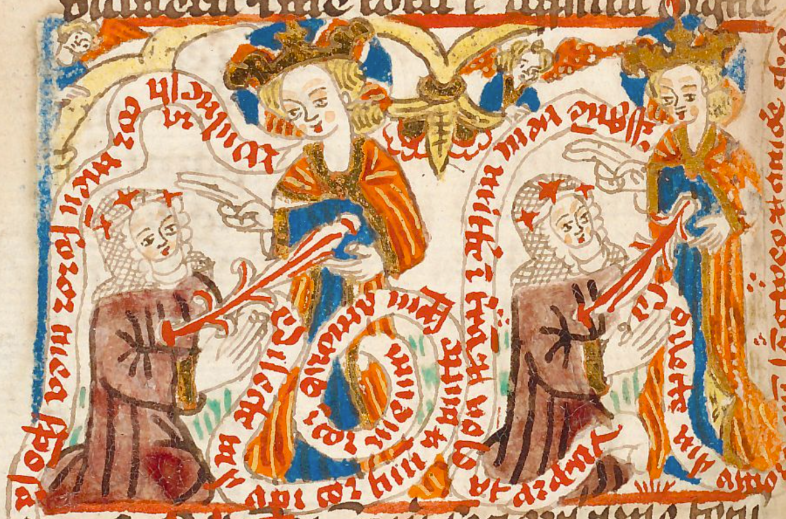
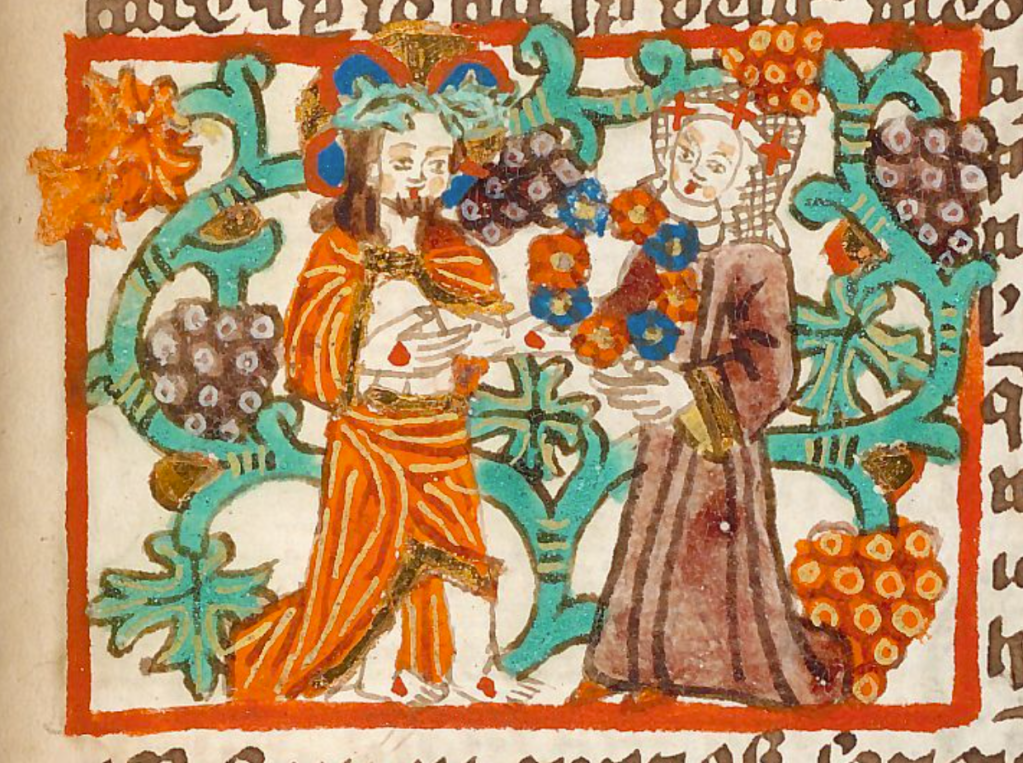
The connection between these books does not rest on a single piece of evidence. Instead, it emerges from a constellation of features: similarities in script, decoration, initials, pen-flourishing, iconography, patronage prayers to St John the Evangelist, and recurring formulations in the Latin and Low German texts. Taken together, these traces suggest that the manuscripts belong to a coherent Buxtehude context.
Calling them the “Buxtehude manuscripts” is therefore not meant to create a new genre. Rather, it makes visible a group of books that has until now been hidden within the broader category of “North German prayer books.”
Why the Buxtehude Manuscripts Matter
The Buxtehude manuscripts are important for several fields at once.
For the history of Low German, they show that the language was not only written in urban chancelleries, chronicles, and literary texts. It was also written, adapted, and transmitted in the scriptoria and devotional settings of women’s convents. The prayers and meditations in these books make the voices of the Buxtehude nuns tangible—not as unfiltered autobiographical testimony, but as carefully shaped texts in which language, piety, and convent history come together.
For the history of devotion, the manuscripts show how Latin and Low German could exist side by side in prayer books. They contain prayers, rubrics, meditations, and liturgical material that reveal a multilingual devotional practice. These books were not static objects. They were tools for prayer, memory, and liturgical participation.
For the cultural history of North German women’s convents, the Buxtehude corpus invites us to look again at networks of exchange. How did prayers and meditations move from one convent to another? What role did nuns play as scribes, compilers, transmitters, and readers? How should we understand the relationship between Neukloster Buxtehude, Lüne, Medingen, Wienhausen, and other religious houses in the region?
Making the Corpus Visible
One of the aims of this blog is to make the Buxtehude manuscripts visible beyond a small circle of specialists.
Some of the manuscripts are already digitally accessible, while others are in the process of being digitised or studied in more detail. Bringing these materials together makes it possible to see, at a glance, how widely the books of one convent are now dispersed: from Stuttgart and Bremen to Hildesheim and Cincinnati.
This also changes how we think about Neukloster Buxtehude. The convent is not merely a local case study. Its manuscripts offer a new point of reference for the study of female religious writing, multilingual devotion, and the transmission of Low German texts in northern Europe.
Cecilia Hüge’s prayer book remains an extraordinary manuscript. But it is no longer alone. Seen alongside the other Buxtehude books, it becomes part of a larger story: a story of women writing, praying, preserving, and transmitting texts across periods of reform, crisis, and confessional change.
Want to Know More?
You can read the full article here:
Carolin Gluchowski, “Die Buxtehuder Handschriften. Lateinisch-niederdeutsche Gebetbücher aus Neukloster als Zeugnisse weiblicher Frömmigkeit,” in Niederdeutsches Korrespondenzblatt 133 (2026), pp. 110–115.



Leave a Reply