

A manuscript does not always reveal explicitly where it was made. Instead, its origins must often be reconstructed from the traces left by its makers: a familiar script, a distinctive pen-flourished initial, or a prayer also found in another book. Identifying where a particular prayer book was produced can therefore become a form of historical detective work.
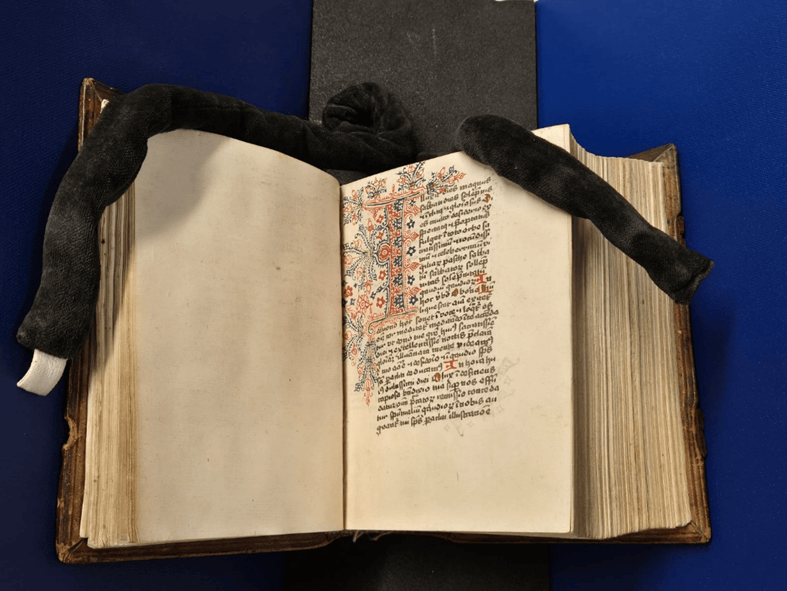
On 24 August 2026, I travelled to the Herzog August Bibliothek in Wolfenbüttel to examine one such manuscript. The HAB is currently holding a prayer book from the Göttingen State and University Library for cataloguing: Göttingen, SUB, 8° Cod. Ms. theol. 233. Patrizia Carmassi is preparing its description for the catalogue of the library’s medieval Latin manuscripts; a detailed provisional catalogue record is already available online.
The manuscript is easy to underestimate. It measures only 14 × 10 centimetres—roughly the size of a postcard—yet contains 536 paper leaves densely filled by several hands. It has no miniatures, but its pages are enlivened by colourful pen-flourished initials in red, green, and blue. This is not a slight private booklet, but a compact devotional archive.
And I believe it was probably made at Neukloster Buxtehude.
Following the Penwork
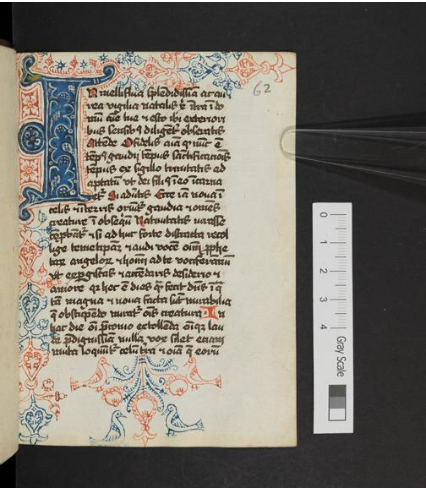
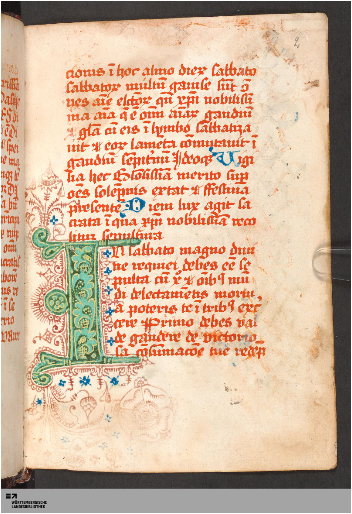
My interest began when the catalogue description pointed to similarities between 8 Cod. Ms. theol. 233and several manuscripts that I have associated with Neukloster Buxtehude: the Latin orationale Bremen, msc 0028; the Low German prayer book Bremen, msc 0014; and, most notably, Cecilia Hüge’s Latin–Low German Easter orationale in Stuttgart, Cod. brev. 22, which can be firmly attributed to Neukloster.
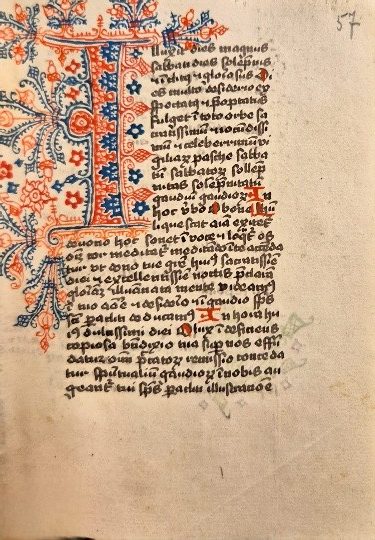
The similarities are evident at first glance: the Bastarda script and the decorative programme—most notably the initials—both closely resemble the Neukloster manuscripts. Red, green, and blue letters open new sections with lively pen-flourishing: parallel lines sprout leaves, flowers, buds, and acorns, while herringbone patterns, diamonds, and stars animate the margins. The effect is vibrant rather than lavish—colour and movement produced economically with pen and ink.
When the Kyrie Becomes an Easter Song
The Easter section brings the Göttingen book even closer to Cecilia Hüge’s Latin–Low German Easter orationale in Stuttgart, Cod. brev. 22. Here the kinship is especially striking: palaeographical, visual, textual, and liturgical similarities converge at the opening of the Easter Vigil Mass.
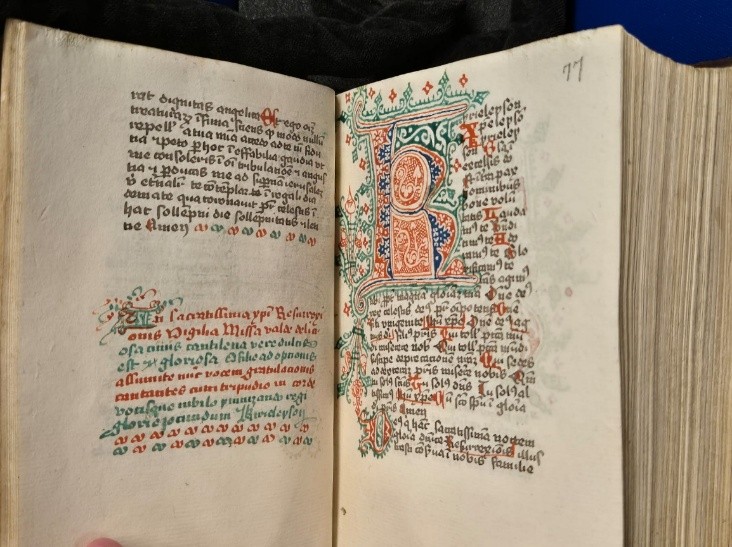
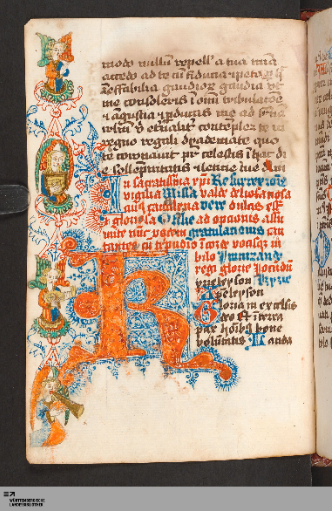
In both manuscripts, the Kyrie of the Easter Vigil Mass receives unusual rhetorical and visual emphasis. The textual comparison is especially compelling because the correspondences extend beyond the prayers themselves. The Göttingen and Stuttgart manuscripts, for example, transmit the same instruction for the Kyrie (Göttingen, fol. 76v; Stuttgart, fol. 35v). This exact correspondence points to an especially close textual relationship between the two Easter sections, whose wider liturgical repertoires now require systematic comparison. In normalized Latin, the rubric reads:
In sacratissima Christi resurrectionis vigilia, missa valde deliciosa, cuius cantilena vere dulcis est et gloriosa. O filiae adoptionis, assumite nunc vocem gratulationis, cantantes cum tripudio in corde votisque iubilo, hymnizando regi gloriae iucundum Kyrie eleison.
At the most holy Vigil of Christ’s Resurrection, there is a most delightful Mass, whose chant is truly sweet and glorious. O daughters by adoption, now take up the voice of rejoicing: sing with exultation in your hearts and jubilation in your prayers, hymning to the King of glory the joyful Kyrie eleison.
The rubric tells the nuns not only what to sing, but how to inhabit the chant. The Kyrie becomes a “voice of rejoicing,” and the women—addressed as God’s daughters by adoption—are placed within the Resurrection’s transformed family.
A comparison with the Easter prayer books from Medingen shows how such instructions could differ between monastic communities. In the Hildesheim manuscript written by Winheid von Winsen (HI1; Hildesheim, Dombibliothek, J 29, fol. 16r), the corresponding rubric reads:
Introitus non canitur eo quod ille, qui est caput et principium nostrum, subtractus est et in sepulchro silet. Incipit ergo officium Kyrie eleison, quae est quaedam vox laetitiae; dic cum ingenti cordis et oris iubilo “Kyrie”.
The Introit is not sung because he who is our head and beginning has been taken away and remains silent in the tomb. The Office therefore begins with the Kyrie eleison, which is a voice of joy; say “Kyrie” with immense jubilation of heart and voice.
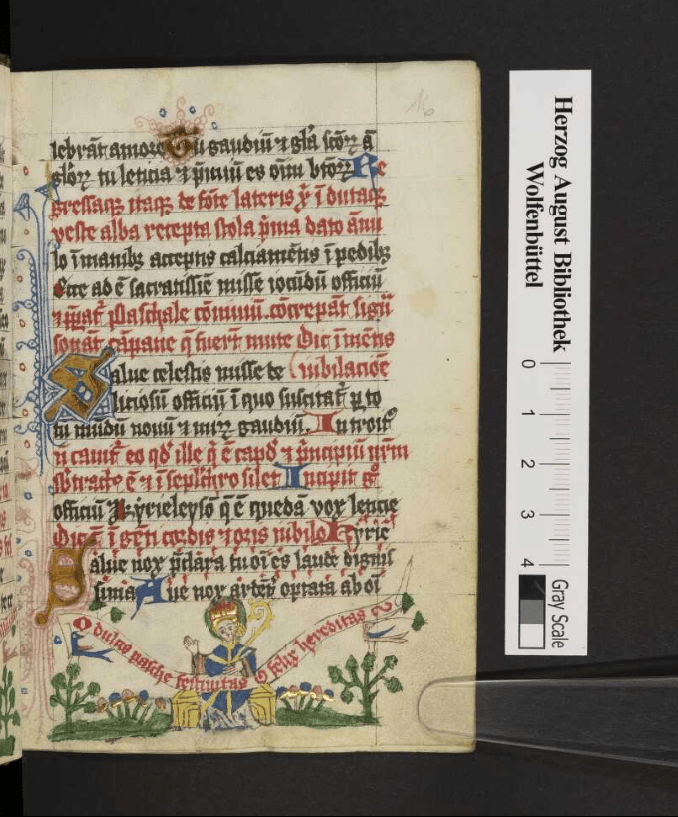
Like the Neukloster rubric, this instruction transforms the Kyrie into an affective practice to be performed with interior and vocal jubilation. Its explanation and wording, however, are markedly different. Rather than addressing the nuns as “daughters by adoption” and inviting them to sing a sweet and glorious chant, the Medingen rubric explains the absence of the Introit through Christ’s silence in the tomb. Some Medingen manuscripts then transmit a Lüneburg-specific Kyrie trope beginning:
Salve nox praeclara, tu omni es laude dignissima! Ave nox ardenter optata ab omni creatura!
Hail, illustrious night, you are most worthy of all praise! Hail, night ardently desired by every creature!
Such differences are particularly revealing. Prayer texts—especially those derived from the liturgy—could circulate widely, whereas rubrics instructing readers how to perform and experience them often display greater local variation. This raises a larger question: which liturgical and devotional elements were shared among northern German women’s communities, and which constituted locally distinctive Eigenmaterial? Systematic comparison can illuminate the development of regional devotional cultures and monastic networks while providing firmer criteria for attributing manuscripts whose origins remain uncertain.
More Than an Easter Prayer Book
8 Cod. Ms. theol. 233is especially exciting because Easter is only one part of it. The book opens with forty leaves for Christmas, followed by prayers for St Stephen, St John the Evangelist, and the Circumcision. Nearly one hundred leaves accompany the Easter Vigil and Easter Day, followed by the Octave and Sundays after Easter. Further substantial units address St John, the Ascension, Pentecost, Trinity and Corpus Christi, several Marian feasts, the dedication of a church, St Michael, and All Saints.
Major feasts are expanded into dense devotional programmes. The reader is guided through vigils, hours, Mass, Communion, and the changing moments of the festive day. Rubrics invite the sponsa Christi, the Bride of Christ, to imagine, greet, embrace, sing, and converse. Prayer unfolds alongside liturgy, turning the church’s feast into an interior experience.
This structure may help explain how specialised books such as Cecilia Hüge’s Easter orationale came into being. 8 Cod. Ms. theol. 233preserves extensive feast dossiers within a broader collection. One section could be copied out, augmented, and developed until it became a book-length enterprise. Cecilia’s 420-leaf Easter manuscript would then appear not as an isolated invention, but as the monumental expansion of a devotional form already present within more comprehensive prayer books.
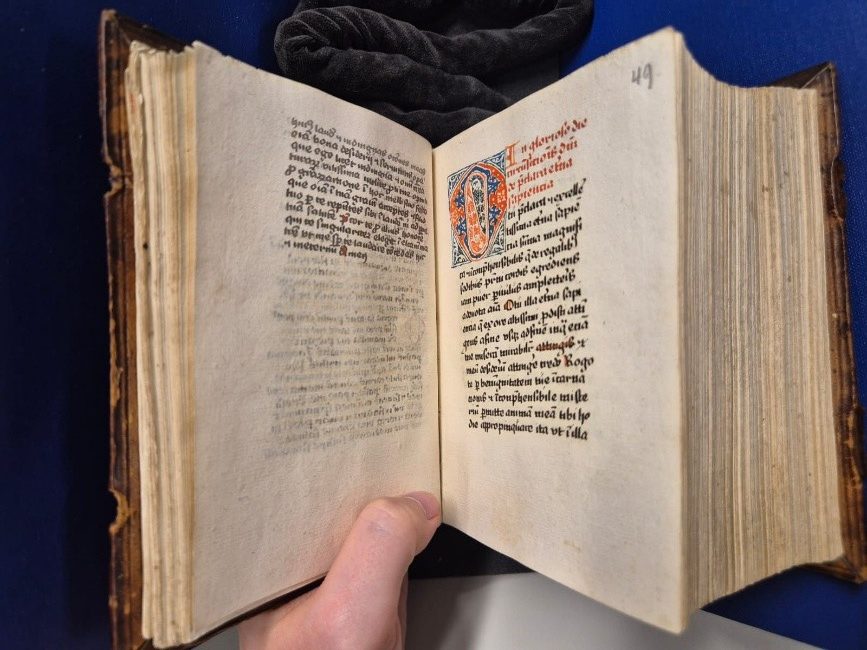
This remains a hypothesis. The manuscript’s quires, hands, and textual layers require closer study. Yet its collaborative production makes the possibility compelling: an Easter orationale may have grown through the repeated work of extracting and enlarging the materials with which a community prayed a feast.
The Church’s Dedication—and an Open Question
The most surprising part of the book may be its section for the dedication of a church. It extends from fol. 381v to fol. 481r—almost one hundred leaves. It begins by asking the Bride of Christ to contemplate two temples: the material church outside her and the spiritual temple of her soul within. A nine-day preparation follows, then prayers accompanying the vigil, Mass, Communion, and the full festive day.
This section provides further evidence for a Benedictine women’s community. On fol. 411v, St Benedict is invited to enter “the dwelling of our monastery” and visit “our congregation.” Even more suggestively, the book calls St John the Evangelist “our patron.” Neukloster was dedicated to the Virgin Mary and St John the Evangelist, making this a significant match. The history of Neukloster also records its Benedictine identity, its reform in 1477, and the destruction and rebuilding of the convent around 1500.
The clue is not conclusive. Carmassi’s catalogue proposes the Benedictine convent of Escherde near Hildesheim as another possible origin, precisely because St John was also honoured there. Johannine patronage alone cannot decide the matter, but it becomes more persuasive when combined with the Göttingen manuscript’s textual and decorative relationship to the Neukloster group.
Can the position of the dedication section tell us when Neukloster celebrated its church dedication? Not yet. It follows the Nativity of the Virgin and precedes the material for St Michael, which might suggest a September anniversary. Yet the book is not consistently arranged according to the calendar. I have not found a reliable source recording the medieval dedication date of Neukloster’s church. The question must remain open until calendars, ordinals, martyrologies, or archival records can be compared.
From Five Manuscripts to Six?
Until recently, Cecilia Hüge’s Easter prayer book was the only manuscript known to come from Neukloster. Five books can now be connected to the convent with high probability. 8 Cod. Ms. theol. 233may be the sixth—and in sheer quantity of text, one of the richest.
The attribution is not yet final. Further palaeographical comparison, a complete textual survey, and detailed study of the quires and watermarks are required. During my visit, I was permitted to photograph only selected leaves, so I will request a full digitisation from the Göttingen library.
For now, this small, densely written volume has already changed the picture. It suggests that the Neukloster manuscripts were not isolated survivals, but the remains of a richer culture of communal writing and prayer. It brings us closer to the workshop in which an Easter feast could grow—leaf by leaf, hand by hand, prayer by prayer—into an entire book.
 Neukloster Buxtehude
Leave a comment